

Hiring in Smaller Communities: Challenges and Strategies

Finding the right candidate can be challenging for any employer, but recruiting in smaller and rural communities can come with a unique set of considerations. A smaller local talent pool, transportation challenges, and competition for qualified workers can make it more difficult to attract and retain employees. For employers hiring outside major urban centres, a successful recruitment strategy often means looking beyond traditional approaches and understanding what makes the local community and the opportunity appealing to candidates. Expand Your Recruitment Radius One of the simplest ways to broaden your talent pool is to expand your recruitment efforts beyond the immediate community. Candidates in neighbouring towns may be willing to commute for the right opportunity, particularly when the position offers competitive compensation, career growth, flexibility, or other benefits. At the same time, employers should be transparent about the work location and expected commute from the beginning. Clear communication allows candidates to determine whether the opportunity is realistically suitable for them. Be Clear About Requirements Clear communication is especially important when hiring in smaller communities. Requirements such as reliable transportation, a valid driver’s licence, specific certifications, or evening and weekend availability should be clearly outlined in the job posting and reinforced throughout the recruitment process. Being upfront about expectations helps employers attract candidates who are genuinely qualified and interested while reducing misunderstandings later in the hiring process. Look Beyond the “Perfect” Candidate When the local talent pool is limited, employers may need to reconsider what makes someone qualified for a role. Rather than focusing exclusively on candidates who have every required skill or years of directly related experience, consider transferable skills, willingness to learn, and overall potential. A candidate with the right attitude and foundational skills may become a strong long-term employee with the right training and support. Highlight What Makes the Community Unique Recruiting in a smaller community isn’t only about overcoming challenges. Employers should also consider what makes these communities attractive places to work and live. Smaller communities can provide opportunities to build meaningful relationships, become more involved locally, and see the direct impact of your work. Employees may also have greater visibility within their organizations and more opportunities to contribute in meaningful ways. For candidates who value connection, community involvement, and making a noticeable impact, these qualities can be an important incentive. Employers can incorporate these advantages into their recruitment strategy by highlighting not only what the position offers, but also what makes the organization and community unique. Build a Local Talent Pipeline Recruitment shouldn’t begin only when a position becomes vacant. Employers can build stronger talent pipelines by developing relationships with local colleges, community organizations, employment agencies, and professional networks. Maintaining relationships with previous applicants can also be valuable. A candidate who wasn’t the right fit for one position may be an excellent fit for a future opportunity. Consider the Bigger Picture Recruitment challenges in smaller communities aren’t always simply about finding enough candidates. Transportation, housing, relocation, access to services, and other practical considerations can influence whether someone is willing and able to take a position. Employers should consider these factors when developing their recruitment strategy and think about how they can make an opportunity more accessible and appealing to candidates from both the local area and surrounding communities. Final Thoughts Hiring in a smaller community may require employers to think differently about recruitment, but a smaller local talent pool doesn’t have to mean limited options. By expanding recruitment efforts geographically, clearly communicating expectations, considering transferable skills, highlighting the benefits of the local community, and building relationships within the area, employers can increase their chances of finding and retaining the right people. The key is to recruit strategically, communicate clearly, and recognize the unique value that smaller communities can offer both employers and employees. Written by: Vrushali Savalia, HR Assistant
Managing Performance in a Hybrid Workplace

When organizations first adopted remote and hybrid work arrangements, many leaders worried about one thing: productivity. Would employees remain engaged? Would collaboration suffer? Could managers effectively supervise teams they couldn’t see every day? Several years later, the conversation has evolved. The question is no longer whether hybrid work can be successful – many organizations have proven that it can. The real challenge is how to manage employee performance effectively in a workplace where some employees are in the office, others work remotely, and many split their time between both. The End of “Management by Visibility” For decades, managers often relied on visibility as an indicator of performance. Employees who arrived early, stayed late, attended every meeting, and were regularly seen in the office were often perceived as high performers. In a hybrid environment, that approach no longer works. Employees who spend more time in the office may naturally receive more face time with leaders, while remote employees may have fewer opportunities for informal interactions. If managers are not careful, this can create unconscious bias in performance evaluations and career development opportunities. The most effective organizations are shifting their focus from activity and presence to measurable outcomes and results. Set Clear Expectations One of the biggest performance management mistakes in hybrid workplaces is assuming employees understand what success looks like. Managers should ensure that employees clearly understand: When expectations are clearly defined, employees are better positioned to perform successfully regardless of where they work. Schedule Regular Check-Ins Hybrid work requires more intentional communication. Managers should establish regular one-on-one meetings to discuss: These conversations should focus on performance, support, and growth rather than simply tracking activity. Employees who feel connected to their manager are more likely to remain engaged and productive. Measure What Matters Many organizations collect significant amounts of workplace data. However, not all metrics are meaningful. Rather than focusing on online status, response times, or hours logged into systems, organizations should identify performance indicators that align with business objectives. Examples may include: Effective performance management focuses on outcomes rather than monitoring employee behaviour. Address Performance Issues Early Hybrid work can sometimes make performance concerns less visible. Missed deadlines, communication challenges, declining quality, or reduced engagement may take longer to identify when employees are not physically present in the office every day. Managers should address concerns promptly and document performance discussions appropriately. Early intervention often prevents minor issues from becoming significant performance problems. A consistent performance management process helps ensure fairness and accountability across the organization. Don’t Forget Employee Development One of the unintended consequences of hybrid work is that learning opportunities can become less visible. In-office employees may have more opportunities to participate in informal mentoring, observe leaders, and build relationships across the organization. Organizations should make a conscious effort to ensure remote and hybrid employees have equal access to: Performance management should not focus solely on current results—it should also support future growth. Looking Ahead Hybrid work is no longer a temporary workplace trend. For many organizations, it has become a permanent part of how work gets done. The most successful employers recognize that effective performance management is not about monitoring where employees work. It is about creating clarity, accountability, communication, and trust. By focusing on results rather than presence, organizations can build high-performing teams that thrive regardless of location. Written by: Gaelle Le Rhun, HR Associate
Your Employees Are Already Using AI. Does Your Business Have the Rules to Match?
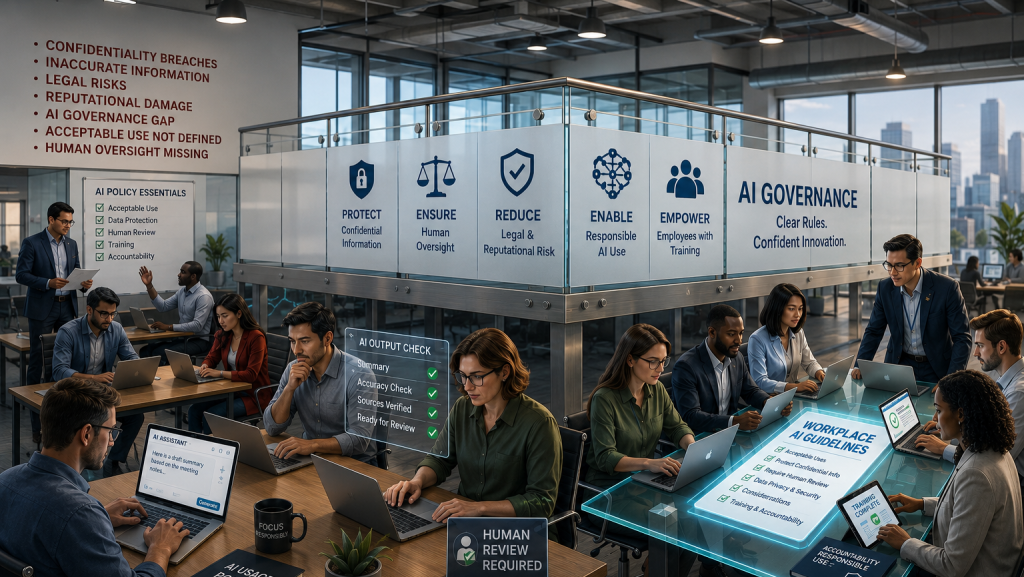
Artificial intelligence is no longer a futuristic concept—it’s already part of everyday business operations. Employees are using AI to draft emails, summarize meetings, create marketing content, analyze data, and even make operational decisions. For Canadian small and mid-sized businesses, the question is no longer whether AI will be used in the workplace. The question is whether it’s being used responsibly. Without clear governance, AI can expose organizations to confidentiality breaches, inaccurate information, legal risks, and reputational damage. Yet many businesses have invested in AI tools without establishing any guidelines for employees. That’s where HR plays a critical role. What Is AI Governance? AI governance refers to the policies, procedures, and accountability measures that ensure artificial intelligence is used ethically, securely, and in alignment with business objectives. For employers, effective AI governance isn’t about restricting innovation—it’s about creating guardrails that enable employees to use technology confidently and responsibly. A well-designed framework should address: These issues affect businesses of every size, not just large enterprises. Why Small Businesses Are Especially Vulnerable Unlike large organizations with dedicated legal, IT, and compliance teams, many small businesses rely on informal processes and lean staffing models. Employees often adopt new technology independently, creating inconsistency and risk. For example: Without governance, these situations can escalate quickly. AI Governance Is an HR Issue Many organizations assume AI oversight belongs solely to IT. In reality, HR has a central role in shaping how employees use technology. Policies should establish expectations for responsible use, while onboarding and training should reinforce those standards. Performance management processes should also address misuse where appropriate, ensuring accountability across the organization. HR professionals can also help leaders evaluate whether AI tools align with workplace values, privacy obligations, and organizational culture. Practical Steps Employers Can Take Today If your business has not yet developed an AI governance strategy, consider starting with these five actions: These simple measures can significantly reduce risk while allowing employees to benefit from productivity gains. How Outsourced HR Can Help For many small and mid-sized businesses, developing governance policies from scratch can feel overwhelming. An outsourced HR partner can bridge that gap by creating practical, business-focused frameworks that support innovation while protecting the organization. From drafting AI usage policies and updating employee handbooks to training managers and advising leadership teams, Bay Street HR can help ensure programs are implemented responsibly—not reactively. The Bottom Line Artificial intelligence is changing the way businesses operate, but governance should evolve alongside technology. Organizations that establish clear expectations today will be better positioned to protect their people, safeguard sensitive information, and maintain the trust of clients and employees alike. AI doesn’t replace sound judgment—it amplifies the importance of it. And with the right governance framework in place, businesses can embrace innovation with confidence instead of uncertainty. Written by: Tiffany Leung, Partner, Consultant
When Should You Bring in a Third-Party HR Investigator?

Workplace complaints can be difficult to manage, especially when they involve sensitive allegations, strained relationships, or senior leaders. Some concerns can be handled internally. But other situations require a more neutral, structured, and independent process. That is where a third-party HR investigator can help. An external investigator provides an objective process for reviewing workplace concerns. They speak with the relevant individuals, review available documentation, assess the evidence, and provide findings based on the facts. The goal is not to “take a side.” The goal is to help the employer understand what happened and respond in a fair, consistent, and defensible way. When Should You Consider a Third-Party Investigator? You may want to bring in an external investigator when: 1. The complaint is serious or sensitive o Complaints involving harassment, discrimination, bullying, sexual harassment, retaliation, or workplace misconduct should be handled with care. o These issues can create legal, reputational, and employee-relations risk. A neutral investigator helps ensure the concern is reviewed properly and that the employer can demonstrate it took the matter seriously. 2. A senior leader is involved o If the complaint involves an owner, executive, partner, or senior manager, an internal process may not feel independent to employees. o Even when leadership intends to be fair, there may be a perception that the outcome is already influenced. Bringing in a third party can help protect the credibility of the process. 3. There is a conflict of interest o Independence matters when the person who would normally handle the complaint is too close to the issue. o This can happen when they: § Manage one of the employees involved § Report to the person named in the complaint § Witnessed part of the situation § Have already formed a view § Have a close working relationship with one of the parties § In these situations, an external investigator can create necessary separation. 4. The conflict has escalated o Not every workplace disagreement requires a formal investigation. o However, if a conflict has become ongoing, personal, disruptive, or connected to allegations of unfair treatment, bullying, or retaliation, a more structured review may be appropriate. o A third-party investigator can help separate facts from assumptions and determine whether workplace expectations, policies, or standards were breached. 5. Employees may not trust an internal review o A process can be well-intentioned and still lack credibility. o If employees believe the company is too close to the issue, or that leadership has already made up its mind, they may be less willing to participate openly. o An independent investigator can help employees feel that the matter is being taken seriously and reviewed fairly. 6. The outcome may be challenged o If the complaint could lead to discipline, termination, workplace changes, or legal scrutiny, the employer needs a clear record of the process. o A proper investigation helps document: § What concerns were raised § Who was interviewed § What information was reviewed § What findings were made § How those findings were reached That record can be important if the employer’s response is later questioned. Why Timing Matters Waiting too long can make a difficult issue harder to manage. Memories fade. Documents may be missed. Employees can become more frustrated. Workplace dynamics can deteriorate. A timely response shows employees that concerns are being taken seriously and helps the employer manage risk before the situation grows. Final Thoughts Bringing in a third-party HR investigator does not mean the employer has failed. It means the employer understands that certain workplace issues require independence, care, and a clear process. For sensitive complaints, leadership concerns, harassment allegations, or situations where neutrality matters, an external investigator can help protect both the employees involved and the organization. At Bay Street HR, we support employers with independent workplace investigations, complaint reviews, and practical next-step guidance. We help organizations respond to employee concerns fairly, professionally, and with the structure needed to make informed decisions. By: Maha Masood, Partner
Degrees and Skills: Finding Balance in Entry Level Hiring

The conversation around hiring is evolving, particularly at the entry level. For many years, a university degree was widely viewed as the primary gateway into the workforce, signaling both knowledge and readiness. Today, however, many organizations are rethinking how they evaluate early career candidates, placing greater emphasis on practical skills alongside formal education. Rather than replacing degrees, this shift reflects a broader effort to better align entry-level hiring with the realities of modern work. At the entry level, one of the biggest challenges employers face is assessing potential. Many candidates have limited full time work experience, so degrees have traditionally served as a proxy for capability. However, employers are increasingly recognizing that academic credentials alone may not fully capture a candidate’s ability to perform in a role. Skills developed through internships, part time jobs, volunteer work, and extracurricular activities are becoming more important indicators of readiness. As a result, hiring practices are expanding to consider a wider range of experiences that demonstrate initiative, adaptability, and problem-solving. At the same time, degrees continue to hold strong value, especially for those entering the workforce. Higher education provides foundational knowledge, but also helps develop critical thinking, communication, and time management skills. For many students, a degree is their first structured exposure to a particular field, and it can signal both commitment and the ability to learn in complex environments. In certain industries, degrees are not only valued but required, making them an essential starting point for entry-level roles. This raises an important question: how should education and experience be weighed early in a career? Increasingly, employers are not choosing one over the other but instead looking for a combination. A degree can provide the theoretical grounding, while hands-on experience, no matter how small, demonstrates how that knowledge is applied. For entry level candidates, even limited experience can make a meaningful difference when paired with a relevant educational background. The growing emphasis on skills in entry level hiring is also influenced by the expansion of alternative learning pathways. Certifications, online courses, and short-term training programs allow individuals to build job relevant skills alongside or outside of traditional education. For students and recent graduates, these options can enhance employability by bridging the gap between academic learning and workplace expectations. It is also important to recognize that this balance shifts over time. At more senior levels, particularly in certain industries, formal education often becomes less heavily weighted compared to years of experience and proven performance. Once individuals have established themselves in their field, employers tend to focus more on what they have accomplished rather than how they initially qualified. In this sense, entry-level hiring is unique, education plays a more prominent role early on, while experience becomes increasingly important as careers progress. For students, this evolving landscape highlights the importance of building both academic and practical experience. While earning a degree remains valuable, complementing it with internships, projects, or skill development opportunities can strengthen a candidate’s profile. Rather than viewing degrees and skills as competing priorities, they are most effective when developed together. From an organizational perspective, this shift can support more inclusive and effective hiring practices. By evaluating both education and demonstrated skills, employers gain a more complete understanding of a candidate’s potential. At the entry level, where traditional indicators may be limited, this broader approach can help identify strong candidates who might otherwise be overlooked. Ultimately, entry-level hiring is becoming less about meeting a single requirement and more about demonstrating overall readiness. Degrees remain an important part of that equation, offering a foundation for learning and growth. At the same time, skills and experience provide insight into how candidates can apply that foundation in practice. As hiring practices continue to evolve, the most successful entry-level candidates will be those who bring both, an educational background that supports their understanding, and practical skills that show their ability to contribute. In today’s talent landscape, it is not a question of degrees versus skills, but how the two come together at the start of a career. By: Abby Duong, HR Assistant
The Hiring Freeze Isn’t Passive: How HR Can Lead Strategic Talent Planning in 2026

For many organizations, hiring in 2026 has become something of a paradox. Headcount growth is paused or heavily scrutinized, yet business demands haven’t slowed. Transformation initiatives continue, teams are stretched, and leaders are still being asked to deliver more — just without adding people. This moment is often described as a “hiring freeze,” but in reality, it represents something more complex. It’s a period of intentional restraint, and it places HR squarely at the centre of strategic decision-making. Unlike past downturns, today’s hiring slowdown is not defined by widespread layoffs or clearly communicated austerity measures. Instead, roles remain open but approvals stall. Backfills that once felt automatic are now questioned. Leaders are encouraged to absorb work internally while keeping engagement and performance high. In this environment, HR’s role shifts from facilitating recruitment to helping organizations think critically about how work gets done in the first place. This shift elevates HR’s strategic importance. When new hires are limited, organizations must understand what capabilities they truly need, not just which roles they have historically filled. HR becomes responsible for helping leaders distinguish between essential skills and legacy job structures. The conversation moves away from titles and toward capacity, adaptability, and risk. In many cases, this requires challenging assumptions — including the idea that every business problem is solved by hiring someone new. One of the most significant changes during a hiring freeze is the growing emphasis on capability-based thinking. Instead of asking whether a role should be filled, HR can help leaders assess whether the required skills already exist somewhere within the organization. This often leads to talent being redeployed across teams, responsibilities being redesigned, or projects being re-scoped to better match available expertise. While this approach demands more planning and communication, it also builds a more resilient and flexible workforce over time. At the same time, constrained hiring puts increased pressure on retention. When external opportunities feel limited internally, high performers may begin looking elsewhere for growth. Career progression becomes less visible, and employees may interpret stalled movement as a lack of investment in their development. In this context, retention is no longer a secondary concern — it becomes the primary talent strategy. HR plays a critical role in helping managers have realistic, transparent conversations about growth, learning, and future opportunities, even when promotions or new roles aren’t immediately available. Upskilling is often presented as the solution to these challenges, but it must be approached carefully. Asking employees to learn new skills without adjusting workloads or expectations can quickly lead to burnout. Effective upskilling during a hiring freeze is targeted and intentional. It focuses on building capabilities that align directly with business priorities and includes clear decisions about what work can be deprioritized to make room for learning. HR’s role here is to ensure that development efforts are sustainable rather than symbolic. Data also becomes increasingly important in periods of restraint. When difficult decisions need to be made about where to invest limited resources, HR insights can help cut through instinct and urgency. Workforce data can identify which roles are truly critical, where skill gaps are emerging, and which teams are at risk of disengagement or attrition. Used well, this information allows leaders to act proactively rather than reactively — and positions HR as a trusted advisor in moments of uncertainty. Ultimately, a hiring freeze does not diminish HR’s influence. If anything, it amplifies it. Organizations that navigate these periods successfully are not the ones that simply pause hiring and hope for stability. They are the ones that use the moment to rethink how talent is structured, developed, and supported. In 2026, HR has the opportunity to act as a stabilizing force — guiding leaders through complexity with clarity, intention, and a deep understanding of the human impact behind every staffing decision. By: Carly Howard, Human Resources Manager
Data-Driven HR: How People Analytics Is Transforming Turnover and Performance

For years, HR has been known as the “heart” of an organization focused on people, culture, and relationships. Today, it is also becoming the brain. Welcome to the era of data-driven HR, where people analytics helps organizations shift from reactive problem-solving to proactive decision-making. Instead of asking, “Why did this employee leave?” leading companies are now asking, “How can we predict and prevent turnover before it happens?” What Is People Analytics? People analytics (also known as HR analytics or workforce analytics) is the practice of collecting and analyzing employee data to improve business decisions. This may include engagement scores, performance ratings, absenteeism trends, promotion timelines, compensation data, training participation, and exit feedback. The goal is not to reduce people to numbers. It’s to use data thoughtfully to improve employee experience and strengthen organizational strategy. Predicting Turnover Before It Happens Turnover is costly both ways: financially and culturally. Replacing an employee can cost anywhere from 30% to 200% of their salary, not to mention the disruption to morale and productivity. Predictive analytics allows HR teams to identify patterns that signal risk. For example: With these insights, HR can take proactive steps such as conducting stay interviews, offering career development opportunities, adjusting workloads, or reassessing compensation structures. The objective isn’t control, it’s support. Improving Performance with Real-Time Insights Traditional performance management often relies on annual reviews, which can delay meaningful feedback. People analytics enables continuous performance tracking and evidence-based decision-making. Organizations can: When data reveals that certain training programs consistently improve performance, those initiatives become strategic investments. When productivity dips align with workload imbalances, leaders can address structural issues instead of placing blame on individuals. Data shifts HR from assumptions to informed action. The Human Side of Data Data should enhance empathy not replace it. Employees want transparency, fairness, and privacy. To use people analytics responsibly, organizations must: Numbers tell part of the story. Conversations complete it. The Future Is Insight-Driven In today’s competitive labour market, intuition alone is no longer enough. Leaders expect HR to demonstrate measurable impact. Data-driven HR strengthens workforce planning, reduces turnover costs, increases engagement, and supports equitable decision-making. It positions HR not just as an administrative function, but as a strategic partner at the leadership table. The most successful organizations in 2026 and beyond will combine human-centered leadership with ethical data practices, continuous learning, and strategic workforce planning. People analytics does not replace the human element of HR, it strengthens it. When empathy is paired with evidence, organizations don’t just improve performance. They build workplaces where employees feel supported, valued, and motivated to grow. Because when HR combines insight with humanity, employees don’t just stay, they thrive. Written by: Vrushali Savalia, HR Assistant
Values Alignment at Work: Why It Matters More Than Ever

In today’s evolving world of work, compensation and job titles are no longer the sole drivers of career decisions. Increasingly, employees and jobseekers are seeking something deeper: values alignment. They want to work in environments where their personal values, ambitions, and life circumstances are respected and reflected, not only by the organization, but also by the people they work with every day. What Is Values Alignment? Values alignment refers to the degree to which an individual’s beliefs, priorities, and expectations are compatible with those of their employer and colleagues. This includes shared views on topics such as integrity, collaboration, accountability, work-life balance, inclusion, growth, and purpose. While organizational values are often articulated in mission statements and codes of conduct, values alignment truly comes to life through employee-to-employeeinteractions. How people communicate, make decisions, handle conflict, and support one another ultimately determines whether values are lived or merely stated. Why Jobseekers Care So Much About Values Alignment Jobseekers today are more intentional about their career choices. Many are asking: For individuals balancing family responsibilities, caregiving, health considerations, or other life circumstances, values alignment can be the deciding factor between accepting or declining a role. Flexibility, empathy, and trust are no longer “nice to have”; they are essential. The Role of Employee-to-Employee Alignment Even in organizations with strong corporate values, misalignment at the team level can quickly erode engagement. Employees experience the workplace primarily through their peers and direct managers. When colleagues share similar expectations around collaboration, accountability, respect, and communication, trust forms more naturally and work becomes more fulfilling. Conversely, misalignment between employees, such as differing views on work ethic, boundaries, or ethical standards, can lead to frustration, disengagement, and conflict, even if the organization’s stated values are sound. Values Alignment Drives Engagement and Retention When employees feel aligned with both the organization and the people around them, several positive outcomes follow: What Employers Can Do Organizations that want to attract and retain top talent must move beyond surface-level values statements and focus on lived experiences. This includes: Most importantly, organizations should recognize that values alignment is dynamic. As employees grow and life circumstances change, ongoing conversations and adaptability are key. A Shared Responsibility Values alignment is not solely the employer’s responsibility. Employees also play a role in communicating their needs, respecting differences, and contributing positively to team culture. The strongest workplaces are built on mutual understanding, where individuals feel empowered to be themselves while working toward shared goals. In Closing Work is no longer just about what we do, it’s about who we do it with and why. As jobseekers continue to prioritize purpose, balance, and authenticity, values alignment between employees and employers, and between employees themselves, will remain a defining factor of healthy, sustainable workplaces. Organizations that invest in this alignment are not only meeting modern expectations; they are building cultures where people can truly thrive. Written by: Gaelle Le Rhun, HR Associate
Ontario’s new AI Disclosure Rules in Hiring

Ontario is taking a clear step toward transparency in hiring. Effective January 1, 2026, employers with 25 or more employees will be required to disclose the use of artificial intelligence (AI) in the recruitment process for publicly advertised job postings. For employers, this is not just a “check-the-box” update to job ads. It requires understanding where AI is actually being used in your hiring process and putting practical controls in place to support compliance. Who the requirement applies to The disclosure obligation applies if all three of the following are true: If you have fewer than 25 employees, the disclosure requirement does not apply — though best practices around transparency and fairness still do. What counts as “AI use” in recruitment? This is where many employers underestimate their exposure. You do not need to be using cutting-edge or custom-built AI for the requirement to apply. If a tool uses automation, machine learning, or algorithmic decision-making to evaluate candidates, it likely counts. Common examples of AI use include: If an AI tool influences who advances and who doesn’t, assume disclosure is required. What the law actually requires Employers must include a clear, plain-language statement in the publicly advertised job posting (and any associated application form) that AI is used in the hiring process. What this actually means:
Bridging the Gap: Navigating Generational Differences in Today’s Workforce

Over time workplaces are becoming increasingly multigenerational. Managing generational diversity has become a crucial challenge and opportunity for Human Resources professionals. With Baby Boomers, Generation X, Millennials, and now Generation Z working alongside one another, HR departments must find ways to align differing values, communication styles, and expectations without causing friction. Each generation brings its own experiences and work philosophies. Baby Boomers often value loyalty, structure, and in-person collaboration. Generation X tends to prioritize independence and flexibility, while Millennials seek purpose, growth, and digital efficiency. Gen Z, the newest cohort, is entering the workforce with a focus on inclusivity, mental health, and work-life balance. These contrasting perspectives can easily lead to misunderstanding if not carefully managed. The Role of HR in Fostering CollaborationHR plays a central role in transforming generational diversity into strength. By encouraging cross-generational mentorship programs, companies can allow younger employees to gain insight from seasoned workers while older staff benefit from the digital fluency and fresh ideas of younger generations. Promoting open communication and feedback loops helps reduce stereotypes and fosters respect across age groups. Adapting Policies for InclusivityA “one-size-fits-all” approach no longer works in today’s workplace. Creating career development paths that reflect different goals and timelines can engage employees at all stages of their careers. For instance, younger workers might prioritize skill-building and advancement, while more experienced employees may value leadership opportunities or mentoring roles. HR leaders should also consider professional development opportunities that are designed to engage everyone: tech upskilling for senior workers, leadership training for younger staff, and well-being initiatives that support all. This isn’t just about accommodating differences, it’s about recognizing the diverse strengths each generation offers. Technology and Communication StylesPerhaps the greatest source of tension between generations lies in how they communicate. While older generations may prefer phone calls or meetings, younger employees lean toward instant messaging and collaborative platforms. HR can ease this by promoting digital literacy training and communication guidelines that clarifies expectations and bridge these differences rather than letting them create silos. Ultimately, effective HR strategy recognizes that diversity, including generational diversity, drives innovation. By promoting empathy, continuous learning, and adaptability, HR professionals can ensure that each generation feels valued and heard. When managed well, generational differences don’t divide a workplace, they enrich it. By: Abby Duong, Human Resources Assistant